
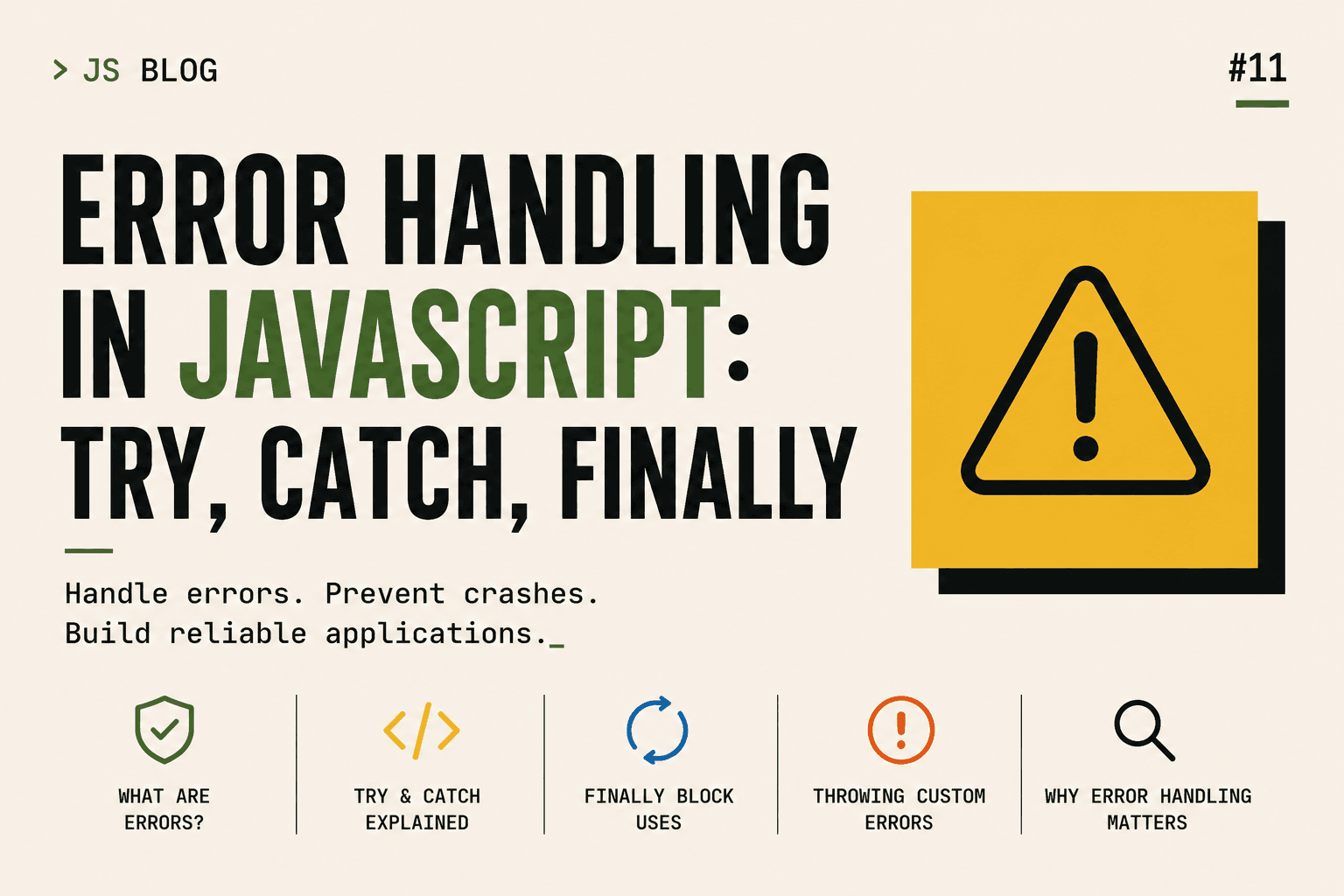
Error Handling in JavaScript: Try, Catch, Finally
When writing JavaScript programs, errors are inevitable. No matter how carefully you code, something unexpected can happen:
A variable might be undefined
An API might fail
A user might input invalid data
A file might not load
The real question is not whether errors happen.
The real question is how your program responds when they do.
Good error handling makes the difference between:
A crashing application
A graceful and controlled failure
Let us build this step by step.
What Are Errors in JavaScript
An error is a problem that prevents JavaScript from executing code normally.
There are different types of errors, but the most common for developers are runtime errors.
A runtime error happens while the program is running.
Simple Runtime Error Example
console.log(user.name);
If user is not defined, JavaScript throws:
ReferenceError: user is not defined
What happens next?
JavaScript stops execution.
Any code after this line does not run.
The application may break.
This is why error handling is important.
Another Example: Invalid Operation
const num = 10;
num();
This causes:
TypeError: num is not a function
Again, execution stops immediately.
Without proper handling, one small mistake can stop your entire program.
The Problem Without Error Handling
Consider this example:
console.log("Start");

let result = JSON.parse("invalid json");

console.log("End");
JSON.parse("invalid json") throws an error because the string is not valid JSON.
Output:
Start
SyntaxError: Unexpected token i in JSON
"End" never prints.
The program crashes at the error point.
This is called unhandled error.
Using Try and Catch
To prevent crashes, JavaScript provides the try...catch mechanism.
Basic structure:
try {
  // risky code
} catch (error) {
  // handle error
}
Let us rewrite the previous example safely.
console.log("Start");

try {
  let result = JSON.parse("invalid json");
} catch (error) {
  console.log("Something went wrong:", error.message);
}

console.log("End");
Output:
Start
Something went wrong: Unexpected token i in JSON
End
Now:
The error is caught.
The program continues running.
Execution does not stop.
This is called graceful failure.
How Try and Catch Work Internally
Step by step:
JavaScript enters the
tryblock.If no error occurs, the
catchblock is skipped.If an error occurs, execution jumps immediately to
catch.The error object is passed into the
catchparameter.The program continues after the
catchblock.
Important detail:
Only runtime errors inside the try block are caught.
Syntax errors outside execution cannot be caught.
The Error Object
Inside catch, you receive an error object.
try {
  undefinedFunction();
} catch (error) {
  console.log(error.name);
  console.log(error.message);
}
Common properties:
error.name→ Type of errorerror.message→ Descriptionerror.stack→ Stack trace
This information is extremely useful for debugging.
The Finally Block
The finally block runs no matter what happens.
Structure:
try {
  // risky code
} catch (error) {
  // handle error
} finally {
  // always runs
}
Example:
try {
  console.log("Trying something...");
  throw new Error("Something failed");
} catch (error) {
  console.log("Caught error:", error.message);
} finally {
  console.log("Cleanup complete");
}
Output:
Trying something...
Caught error: Something failed
Cleanup complete
Even if an error occurs, finally executes.
Why Finally Is Useful
It is commonly used for:
Closing database connections
Stopping loaders
Releasing resources
Logging completion
Example:
function processFile() {
  try {
    console.log("Opening file...");
    throw new Error("File corrupted");
  } catch (error) {
    console.log("Error processing file");
  } finally {
    console.log("Closing file...");
  }
}

processFile();
Even if processing fails, the file is "closed."
Throwing Custom Errors
Sometimes you want to create your own error.
Use the throw keyword.
function divide(a, b) {
  if (b === 0) {
    throw new Error("Division by zero is not allowed");
  }

  return a / b;
}

try {
  console.log(divide(10, 0));
} catch (error) {
  console.log("Custom Error:", error.message);
}
This allows you to:
Validate inputs
Enforce business rules
Stop invalid operations early
Creating Specific Error Types
JavaScript has built-in error types:
ErrorTypeErrorReferenceErrorSyntaxErrorRangeError
Example:
throw new TypeError("Invalid data type provided");
Choosing the correct error type improves clarity.
Why Error Handling Matters
Error handling is not just about preventing crashes. It is about building reliable systems.
Without error handling:
Applications crash unexpectedly
Users see blank screens
Debugging becomes harder
Production systems become unstable
With proper error handling:
Applications fail gracefully
Users see meaningful messages
Logs capture useful debugging details
Developers can trace issues quickly
Debugging Benefits
Consider this unsafe code:
const data = fetchData();
console.log(data.user.name);
If data.user is undefined, the program crashes.
With error handling:
try {
  const data = fetchData();
  console.log(data.user.name);
} catch (error) {
  console.error("Data structure issue:", error);
}
Now you:
Capture the problem
Log useful debugging information
Prevent full application failure
Good error messages make debugging 10 times easier.
Common Mistakes to Avoid
Catching errors and ignoring them silently
Using try/catch for normal control flow
Not logging error details
Catching errors too broadly
Example of bad practice:
try {
  riskyCode();
} catch (error) {
  // nothing
}
This hides problems and makes debugging difficult.
Conclusion
Errors are a natural part of JavaScript development. Runtime errors can stop program execution if not handled properly.
The try...catch structure allows you to:
Catch runtime errors
Prevent application crashes
Handle failures gracefully
The finally block ensures cleanup logic always runs.
The throw keyword allows you to create custom errors and enforce rules.
Proper error handling improves reliability, debugging, and overall software quality. It transforms fragile applications into stable and maintainable systems.